


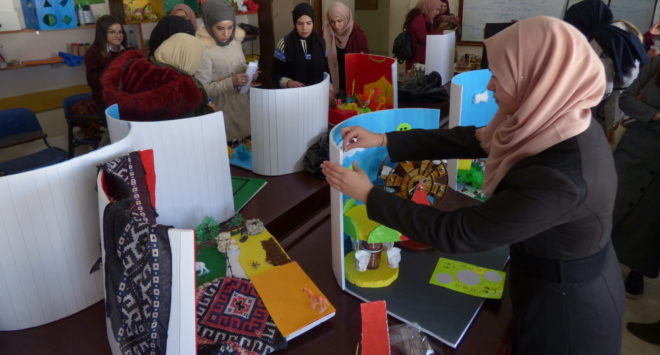
Kindergarten
The main goal of all colleges is achieving a harmonization between the most important educational outputs’ graduates’ and the local market needs, however, reaching that goal depends on the ability of these colleges in proving the basic inputs such as human cadres, programs, tools, and educational methods that the student needs to require. in order to achieve this colleges need to provide the market with talented graduates who are able to enter the market and keep up with its conditions and developments, although, despite all the availability of majors in colleges, it has become a necessary condition to cover the labor market, however, this condition requires a complete harmonization between the need of the public and private sector.
Therefore, Al-Ummah college and under all the tough circumstances that facing it, such as lack of registration because of the separation wall that surrounded it from the south and west.
The college administration took the initiative in raising the level of education in it by finding a new major a bachelor degree in kindergarten education.
Because the early childhood stage is one of the most important stages in building the personality of any individual in society, because taking care of children in that early stage has a great return on the society and on the family, that’s why many countries have moved its education development plan into focusing on that stage and make education during this stage mediatory.
Course Plan
Education Program: Bachelor degree in kindergarten education (130) hours.
- Major courses 82 credit hours
| Course No. | Course Name | Hours | Prerequisite | Year / Course | Course Description |
|---|---|---|---|---|---|
| 2401214 | Guidance principles and psychological counseling. | 3 | 2401108 | ||
| 2401215 | Art and craft in early childhood education. | 3 | |||
| 2401221 | Special education | 3 | 2401109 | ||
| 2401440 | Education tools and equipment's in early childhood stage. | 3 | 2401215 | ||
| 2401220 | Working with parents | 3 | |||
| 2401110 | Early childhood evaluation | 3 | |||
| 2401443 | Community service | 1 | |||
| 2401439 | Computer in early childhood education. | 2 | |||
| 2401329 | Children literature.. | 3 | |||
| 2401326 | Community education in kindergarten. | 3 | |||
| 2401330 | Field training 1 | 1 | |||
| 2401441 | Kindergarten | 2 | 2401332+2401216+2401326 | ||
| 2401332 | Kinetic and play education. | 3 | |||
| 2401336 | Field training 2 | 2 | |||
| 2401447 | Teaching science and math for kids | 3 | |||
| 2401222 | Planning and developing child education program. | 3 | 2401110 | ||
| 2401664 | Field training 3 | 1 | |||
| 2401442 | Moral education in kindergarten | 3 | 2401332 | ||
| 2401449 | Field training 4. | 1 | |||
| 2401448 | Family role | 3 | |||
| 2401108 | educational Psychology | 3 | |||
| 2401333 | Drama for children’s teacher | 3 | 2401108 | ||
| 2401109 | Child growth, health, and nutrition. | 3 | |||
| 2401106 | Child sociology. | 3 | |||
| 2401334 | thinking skills improvement. | 3 | 2401328 | ||
| 2401111 | Music in early childhood education. | 2 | 2401103 | ||
| 2401217 | Research in early childhood | 3 | 2401106 | ||
| 2401444 | Story telling | 3 | 2401329 | ||
| 2401216 | Observation in kindergarten. | 1 | |||
| 2401328 | Language and thoughts | 3 | |||
| 2401103 | Teaching art for children’s | 2 | |||
| 2401450 | Kindergarten music and songs | 2 | 2401111 | ||
| 2401451 | Childhood problems and behavior modification methods for kindergarten. | 3 |
- Courses University Requirements (18) credit hours, all of which are theoretical
| Course No. | Course Name | Hours | Prerequisite | Year / Course | Course Description |
|---|---|---|---|---|---|
| 2401102 | Arabic language skills(1) | 3 | It is an obligatory requirement: it includes the unit of cognitive achievement and includes: levels and methods of developing words, dictionaries, common mistakes, dictation and punctuation, and aesthetic taste unit, which includes: the study of Surat Al-Alaq, the commentator of Al-Qais, the narrator of Abi Al-Tamam and the reader of the cup Nizar Qabbani. The art of the story and the art of biography, and the unit of cultural reconnaissance, which includes: music of free poetry, Arabic language, modern civilization, the Arab cause and the problem of Arabic calligraphy, and the unit of job performance, which includes: readings of all kinds and expression, writing technical reports in Arabic | ||
| 2401107 | Arabic language skills(2) | 3 | Derivatives (succinctly), sections of nouns in terms of their late and Arabization, fold and plural, sections of the Arabic sentence in terms of form and cross, and the pillars of each of them, sections of the sentence in terms of meaning (news and construction), negligence and knowledge (interest in reference names and conductors and the link of the conductor and letters Connected - source), training on sound reading, verbal and technical text analysis, training on oral expression on different topics and situations in a proper language, training on editorial expression and application of skills in (1) and (2), observance and employment. | ||
| 2401101 | English language skills(1) | 3 | It aims to develop the student's four basic skills, namely: writing, reading, comprehension, correct pronunciation and conversation, as well as developing basic language grammar that includes verbs, direct speech, prepositions and conditional sentences, and also aims to provide the student with English words and terms that relate to the student's daily and practical life, writing technical reports In English | ||
| 2401213 | English language skills(2) | 3 | This course is prepared to review and expand the skills presented by the previous course (English Language Skills / 1), with the aim of providing more opportunities for applying sub-reading skills, the most important of which are: introductory reading: surveying and browsing, forecasting of what will appear in the text, reasoning, taking notes, identifying key ideas. Listening skill: Take notes and organize them effectively, paragraph writing skills, summaries, short reports, practice of oral communication, reporting and short oral summaries, exposure to grammar that arises during teaching only. | ||
| 2401219 | Research Methodology | 3 | --- | ||
| 2401337 | Entrepreneurship (1) | 1 | Training units aiming to develop entrepreneurial skills and to prepare young people, on the scientific level, not only to be able to create their own projects in the future, but also to work productively in small and medium-sized enterprises, and thus the goal of the overall program, at the broader level, is to contribute to the development of An institutional culture in Palestine | ||
| 2401338 | Entrepreneurship (2) | 2 | Training units aiming to develop entrepreneurial skills and to prepare young people, on the scientific level, not only to be able to create their own projects in the future, but also to work productively in small and medium-sized enterprises, and thus the goal of the overall program, at the broader level, is to contribute to the development of An institutional culture in Palestine |
- Free Courses (6) credit hours: The first course is theoretical and practical, and the second is theoretical
| Course No. | Course Name | Hours | Prerequisite | Year / Course | Course Description |
|---|---|---|---|---|---|
| 2401325 | Introduction to Computers | 3 | The student learns the physical components of the computer and enables the student to operate the computer and its software, and the use of this software in word processing, building tabular data, and designing databases and presentations. The course begins with introducing the computer and its importance and deals with the most important equipment used for entry, exit, processing and storage, as well as the relationship between information technology and society, the problems associated with the use of the computer and preventive measures when using it and seeking confidentiality and security of information, also will be identified the privacy issues associated with the use of the computer and the identification of computer viruses and how to prevent Including securing programs and data, and displaying concepts of computer cases and ethics. Then the course reviews the general software and its applications, as it shows how to operate the computer through the operating system, and is known as the operating system (windows), then it deals with how to create and edit texts in various forms through a word processor and how to create electronic tables and make graphs using the excel system and provides how to operate Create presentation slides including text, graphics and images using the PowerPoint system. |
||
| 2401424 | Principles of Statistics | 3 | It aims to introduce the student to the role of statistics in life and in the method of research and investigation, and deals with iterative and probability distributions and the normal curve. It also deals with the topic of correlation and regression in a simple way. Nature of statistics, presentation of statistical data, measures of central tendency and dispersion, correlation and regression coefficient. Time Series, Natural Distribution, Vital and Population Statistics and Probability. |
- Courses College requirements are compulsory (12) credit hours, all of which are theoretical except for sports education, both theoretical and practical:
| Course No. | Course Name | Hours | Prerequisite | Year / Course | Course Description |
|---|---|---|---|---|---|
| 2401105 | General Sciences | 3 | Students acquire scientific knowledge of the nature of science and the goals and methods of teaching and evaluation, and how to analyze science lessons, and design models for educational situations that are implemented through various methods of teaching science and dramatic situations and concept maps to teach science lessons and develop positive and valuable directions towards the subject of science. | ||
| 2401327 | Methods of teaching writing | 3 | This course introduces students to the methodology of teaching writing within the following main areas: Arabic Calligraphy Models Dictation and how to overcome difficulties in it. The Art of Writing: Sources, References, and Methods of Making Use of It. Title, phrasing and target |
||
| 2401112 | Foundations of mathematics | 3 | --- | ||
| 2401218 | Sports education | 2 | This course examines the study of the concept of physical education, its goals, and its relations with general education, the definition of the most important skills and basic principles of some group and individual games with the laws of these games, conducting internal and external games and activities, training in refereeing matches and activities, and getting acquainted with some field injuries that affect the player inside and outside the stadium. And knowing its causes, symptoms and methods of first aid, and this course also deals with some athletics competitions and how to organize some methods of sports courses. | ||
| 2401335 | The seminar | 1 | This course gives students at the graduation stage an opportunity to review, organize and collect materials from previous specialization courses. Participants in the seminar provide reports for open discussion with members of the faculty staff who assist as work supervisors or sources for consultation in discussion sessions. Done. Attendance is a prerequisite |
University elective requirements (12) credit hours
| Course No. | Course Name | Hours | Prerequisite | Year / Course | Course Description |
|---|---|---|---|---|---|
| 2401445 | Kindergarten class management | 3 | |||
| 2401331 | Islamic studies | 3 | |||
| 2401223 | Human civilizations | 3 | |||
| 2401104 | Language skills | 3 |